How to Travel More Sustainably in and out of the UK
Ferry travel tips
Ferry travel tips

With climate change and over tourism making regular headlines, sustainable travel is becoming more and more of a focus. But travelling sustainably doesn’t mean you have to holiday close to home. You can still venture beyond the UK – it’s all about making choices that reduce your environmental impact and help protect the planet and the places you visit.
Sometimes it’s the little things can make a big difference, whether that’s choosing a more eco-friendly way to reach your destination, avoiding travelling in peak season or using public transport when you’re there, it all adds up.
So, whether you’re dreaming of a Spanish coastal escape or exploring hilltop villages in France, here are a few things to consider before you book.
One of the most important decisions when it comes to sustainable travel is how you reach your destination. Choosing a mode of transport with a lower environmental impact can make a significant difference to the overall footprint of your trip.
Trying to decide between flying and taking the ferry? Flying may often be the fastest way to get from A to B, but travelling by ferry has plenty of benefits. Not only can you get up, stretch your legs, enjoy live entertainment or go shopping, but there’s also another reason to choose the ferry over flying: it’s a more eco-friendly alternative to flying.
On average, a ferry passenger generates around 19g of CO₂ per kilometre, compared with around 186g of CO₂ per passenger on a short-haul flight. Depending on the route and how you travel, the difference can be huge.
For travellers heading from the UK to destinations such as Ireland, France and Spain, travelling by ferry can therefore be a more environmentally-friendly alternative to flying, especially when combined with other lower-carbon forms of transport such as rail or public transport.
Taking a car with you does increase the emissions, but it often still has a lower carbon footprint than flying.
For an even lower-impact journey, choose a conventional ferry over a high-speed ferry. Conventional ferries generally use less fuel so produce lower CO₂ emissions per passenger.
Operators such as Brittany Ferries offer regular crossings from the UK to destinations in France and Spain. Travelling as a foot passenger and reaching the ports by public transport can provide a more sustainable alternative.
Here are two examples of journeys from London using Brittany Ferries where taking the ferry is more eco-friendly than flying:
By air: Fly from London to Paris.
More sustainable alternative: Take the train from London to Portsmouth, travel with Brittany Ferries from Portsmouth to Caen (Ouistreham), and then take a bus or taxi to Caen station for a train to Paris.
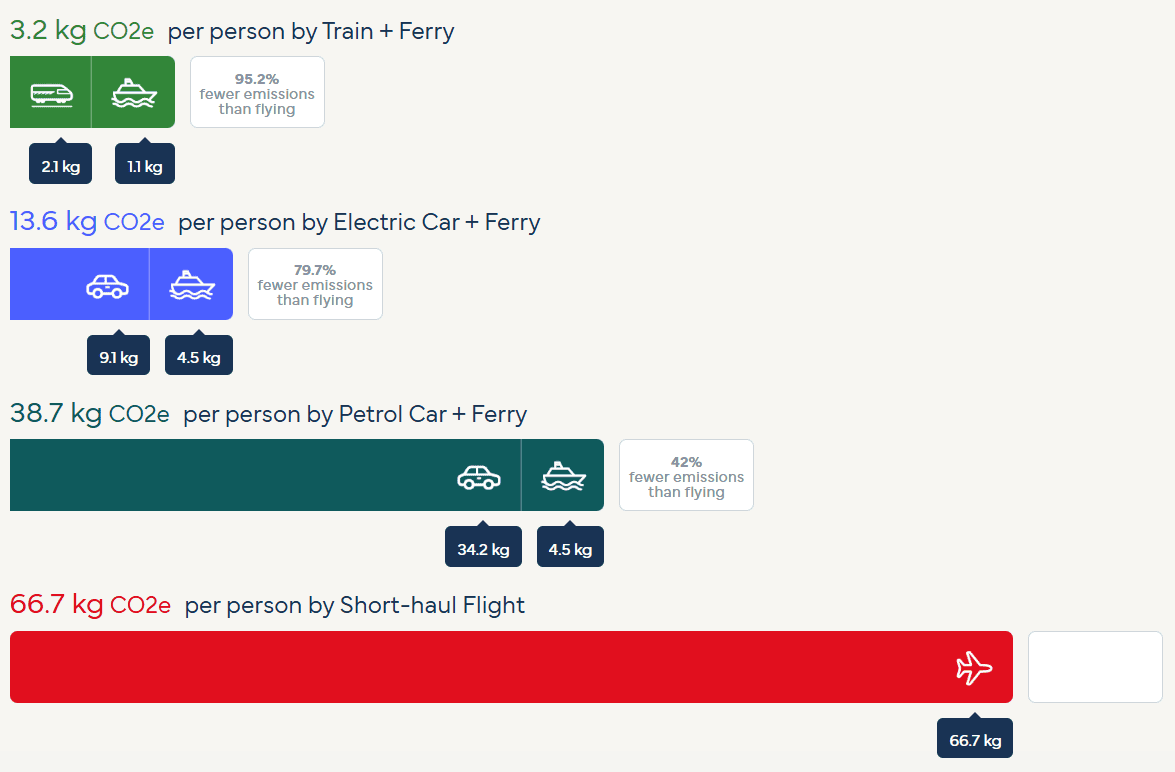
By air: Fly from London to Bilbao.
More sustainable alternative: Take the train from London to Portsmouth, then travel with Brittany Ferries from Portsmouth to Bilbao.
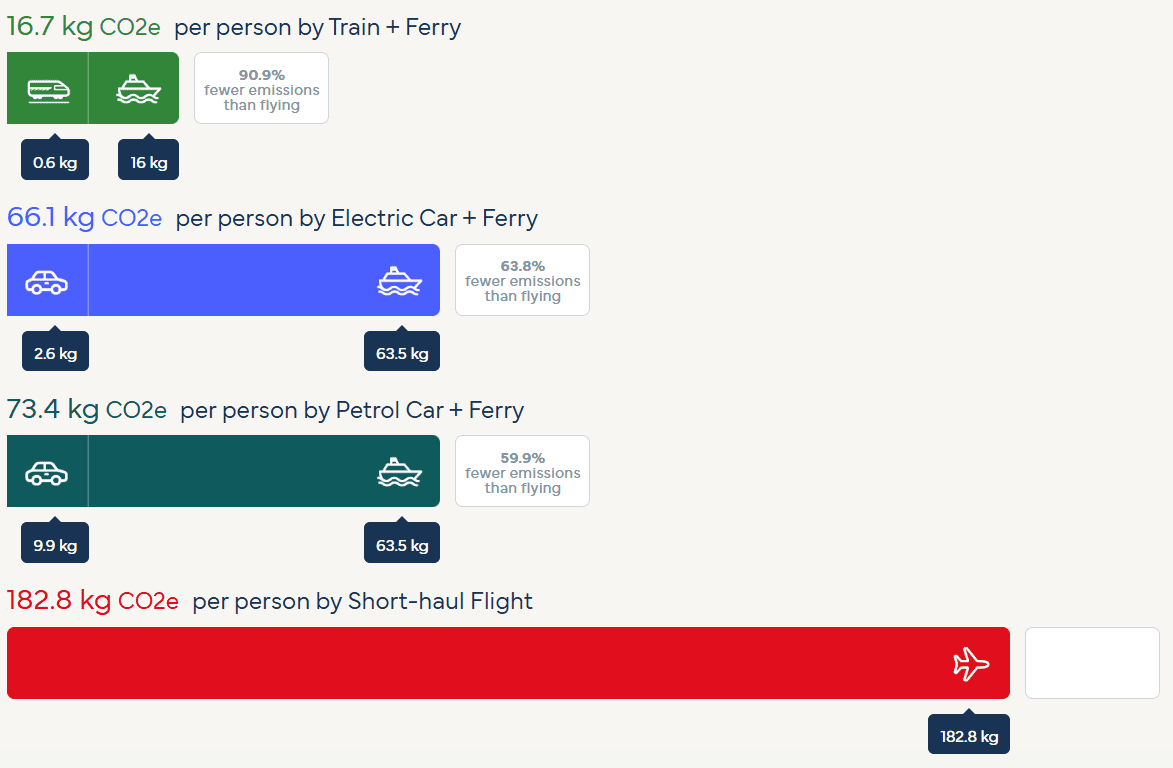
*These results are based on 2 people travelling together.
Want to compare the carbon footprint of your journey? Use our carbon footprint calculator to find the most sustainable way to reach your destination.
Ferry companies are increasingly looking at ways to reduce the environmental impact of their services. Brittany Ferries, for example, received the Green Marine Europe environmental certification for the sixth consecutive year in 2025 and has introduced a number of initiatives to make its operations more sustainable.
Here are some of the ways Brittany Ferries is working to reduce its environmental impact:

Sustainable travel isn’t just about how you get there – the choices you make once you arrive can make a difference too. From where you stay to how you explore, there are plenty of ways you can make your holiday more sustainable. Here are some of our top tips:
With a range of operators offering routes between the UK and Europe, travelling by ferry can be a more sustainable way to start your adventure.
Brittany Ferries offers routes from the UK to France and Spain, with sailings from ports including Poole, Portsmouth and Plymouth. However, other operators also offer routes between the UK and Europe too, giving you plenty of choice when planning a more sustainable journey.
| Operator | Destinations | Ferry routes |
| Brittany Ferries | France, Spain | France: Portsmouth to Caen Poole to St Malo Poole to Cherbourg Portsmouth to Cherbourg Portsmouth to Le Havre Plymouth to Roscoff Portsmouth to St Malo Spain: Portsmouth to Bilbao Plymouth to Santander Portsmouth to Santander |
| DFDS Seaways | France, Netherlands | France: Dover to Calais Dover to Dunkirk Newhaven to Dieppe Netherlands: Newcastle to Amsterdam |
| Irish Ferries | France, Ireland | France: Dover to Calais Ireland: Holyhead to Dublin Pembroke to Rosslare |
| P&O Ferries | France, Netherlands | France: Dover to Calais Netherlands: Hull to Rotterdam |
| Stena Line | Netherlands | Netherlands: Harwich to Hook of Holland Ireland: Holyhead to Dublin Fishguard to Rosslare |

Travelling more sustainably doesn’t mean you can’t leave the UK. It’s all about making more eco-conscious choices when travelling – such as starting your journey by ferry. At Direct Ferries, we make it easy to compare routes and crossings, so you can find a sailing that suits you.