Things to do Galway
Things to do Galway
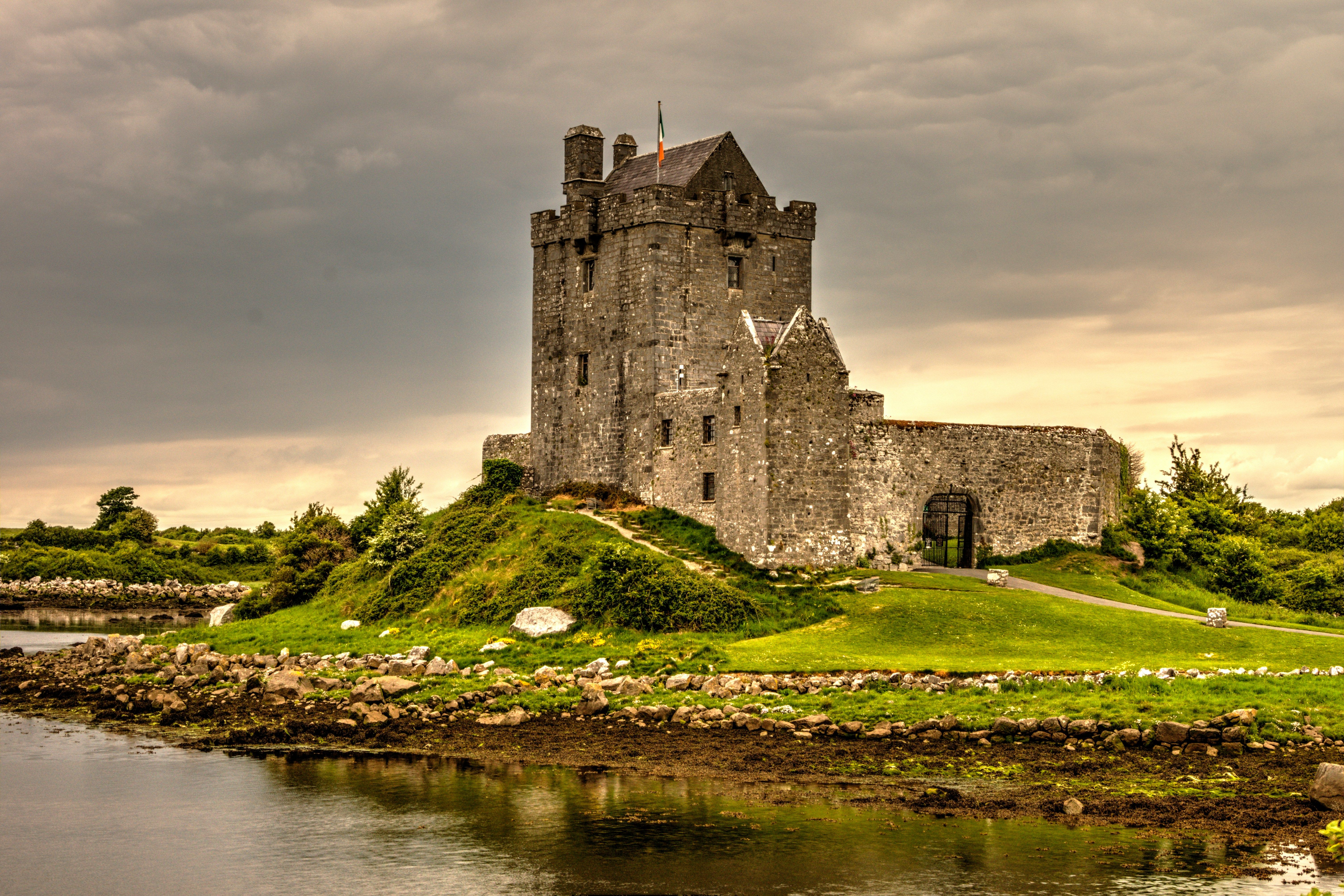
Galway is the bohemian capital of Ireland's west coast. It is a city of cobbled medieval lanes, vibrantly coloured shopfronts, and one of the most exuberant festival cultures of any city in Europe. Galway lies at the point where the River Corrib meets Galway Bay on the western edge of Ireland, looking out across the Atlantic towards North America, and behind it is a landscape of such beauty that Galway has become the epicentre of Ireland's 2,500km Wild Atlantic Way coastal route.
The city itself is small enough to cover on foot in a single afternoon, but County Galway and the wider Connacht region offer a further supply of remarkable scenery, from the rugged moonscape of Connemara to the prehistoric cliffs and forts of the Aran Islands.
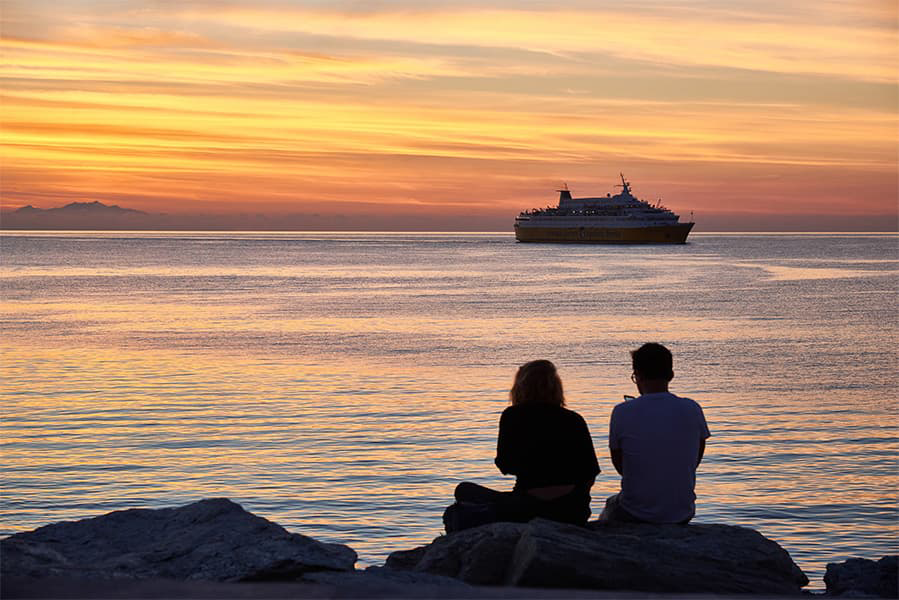
For visitors arriving from the UK, Galway is easily reached by taking the Holyhead to Dublin ferry and driving west for approximately 2 hours, or by taking the Fishguard to Rosslare ferry or the Pembroke to Rosslare ferry and driving northwest for approximately 3 hours. Either route places you in one of the most captivating cities in Ireland with the entire Wild Atlantic Way on your doorstep.
Galway has no direct ferry from the UK, though it can be easily reached by combining one of Ireland's two main ferry ports with a straightforward drive to the west.
The most popular route is the Holyhead to Dublin ferry, operated by both Irish Ferries and Stena Line, with up to ten sailings per day and sailing times ranging from 2 hours and 15 minutes on the fast catamaran to 3 hours and 30 minutes on the conventional ferry.
From Dublin port, Galway is located approximately 2 hours west via the M6 motorway.
Alternatively, the Fishguard to Rosslare ferry or the Pembroke to Rosslare ferry arrive at Rosslare Europort in County Wexford, approximately 3 hours north-west from Galway via Waterford, Tipperary, and Limerick on both the M9 and M18 motorways.
Going via Dublin is the fastest and most frequent route to Galway from the UK. From Holyhead, which you can reach from London Euston by Avanti West Coast train in approximately 3 hours and 45 minutes, the Holyhead to Dublin ferry drops you at Dublin ferry port. The drive from Dublin Port to Galway city centre takes approximately 2 hours with no traffic and passes through Maynooth, Athlone, and Ballinasloe via a fast dual carriageway.
For visitors travelling from northern England, the overnight ferry from Liverpool to Dublin, operated by P&O Ferries, takes 8 hours and drops you in Dublin for a morning arrival.
Going via Rosslare is better suited for visitors travelling from south Wales, south-west England, and the Bristol/Cardiff area who prefer Pembroke or Fishguard over the longer drive to Holyhead. From Rosslare Europort, the route to Galway takes 3 hours and runs north-west via the M9 through Waterford and Kilkenny, then the M8 and M7 through Tipperary and Limerick, and north on the M18 to Galway.
This route also fits perfectly into a circular south-west Ireland itinerary, arriving at Rosslare, driving north-west to Galway, exploring Connemara, then returning south via Limerick, Cork, and Wexford before heading back on the Rosslare to Fishguard ferry or the Rosslare to Pembroke ferry for the return crossing.
Galway is very well connected to Dublin by both rail and coach. Irish Rail's intercity service from Dublin Heuston to Galway Kent Station operates multiple times each day with an average travel time of approximately 2 hours and 10 minutes.
Bus Éireann and Citylink both provide frequent express coaches from Dublin city centre and Dublin Airport to Galway's Ceannt Station bus terminal, with travel times of approximately 2 hours and 15 minutes, depending on traffic. For foot passengers arriving on the Holyhead to Dublin ferry, Busáras (Dublin's main bus station) is located approximately 20 minutes by taxi from the ferry terminal and has direct Galway coaches departing frequently throughout the day.
Galway has one of the most walkable city centres in Ireland. The historic centre, spanning from Eyre Square in the east to the Spanish Arch and harbour in the west, is small enough to cover on foot in under 30 minutes. The cobbled lanes of the Latin Quarter, the shopfronts of Shop Street and Quay Street, and the riverside walks along the Corrib are best experienced at a slower pace.
However, a car is essential for those who want to explore County Galway and the wider west, such as Connemara and the Cliffs of Moher, as these are not accessible by public transport.
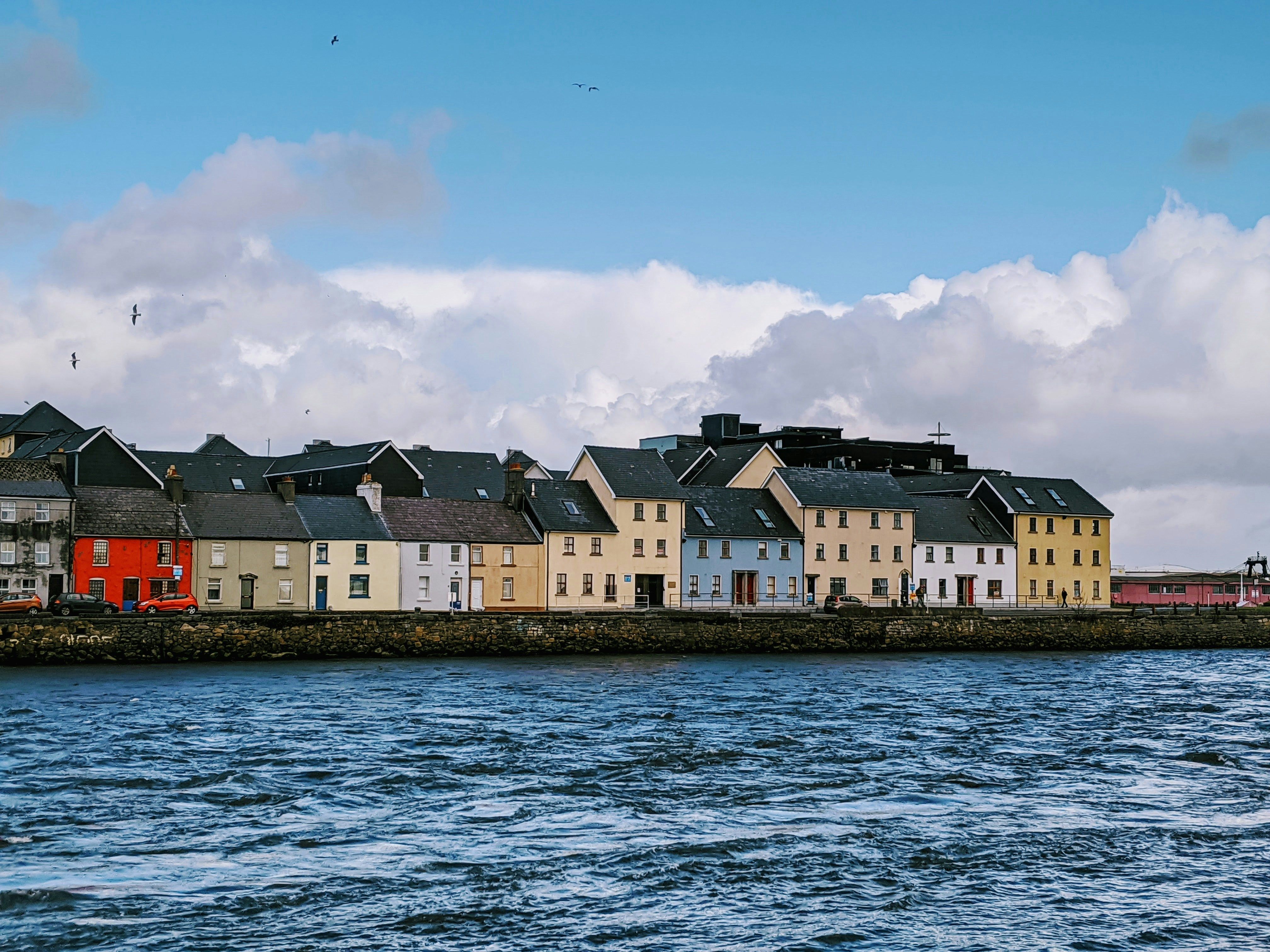
The walk from Eyre Square west along Shop Street, High Street, and Quay Street to the Spanish Arch takes approximately 12 minutes and passes through the heart of the Latin Quarter, where you will find plenty of independent shops, pubs and restaurants. From the Spanish Arch, the Long Walk follows the eastern shore of the Corrib to the point where the river meets Galway Bay, giving the classic view of the painted houses of Long Walk reflected in the water.
Having a car makes it much easier to explore beyond Galway city and reach many of the region’s most famous sights. Several attractions are within easy driving distance:
One of the most scenic drives in the region is the Sky Road loop near Clifden. This 16 km circular route runs along dramatic clifftops above the Atlantic Ocean, offering sweeping views of the offshore islands and the Twelve Bens mountain range.
Citylink and Bus Éireann operate services from Galway city centre to Clifden, Letterfrack, Leenane, and the main towns of County Galway, making exploration possible for those travelling without cars. The Aran Islands ferry from Rossaveal, with a connecting bus from Galway city centre, runs throughout the whole year and is the most popular car-free excursion from the city.
Galway has a mild Atlantic climate, though it's frequently wet and can experience the full force of Atlantic weather systems in winter. The city is a year-round destination driven by its festival calendar and pub culture, but the period between May and September marks the peak season for outdoor exploration of Connemara and the coast.
Two of the city’s most celebrated events, the Galway International Arts Festival and the Galway Races, take place in July, meaning accommodation books out months in advance.
Temperatures vary from 8–15°C through spring, and the Connemara landscape is at its most vivid in April and May when the bog cotton flowers across the moorland and the hedgerows along the coastal roads are in early leaf. The pubs and restaurants across the city are operating without the influx of summer visitors, and the Aran Islands can be visited with the advantage of fewer crowds.
Perfect for: the Cúirt Literary Festival (April), the Aran Islands without summer crowds, Connemara in spring bloom, and the best hotel rates before the summer peak season.
Temperatures can reach 17–21°C on the warmest summer days, though we still recommend that you pack a jumper and a coat as wind and rain are common during any season. The Galway International Arts Festival, the largest arts festival in Ireland, get underway in mid-July for two weeks of theatre, music, visual art, street spectacle, and talks that draw around 200,000 visitors every year. The Galway Film Fleadh, in the same week, is one of Ireland's leading international film festivals. The Galway Races at Ballybrit, running for six days in late July, is the largest horse racing festival in Ireland, with the Thursday Ladies' Day drawing up to 50,000 people.
Perfect for: the Galway International Arts Festival (July), the Galway Races (late July), the Cliffs of Moher and the Burren in summer, Salthill beach, and the longest days of the Atlantic year.
The Galway International Oyster and Seafood Festival in late September is the most Galwegian event in the annual calendar. The Macnas Halloween Parade in late October is one of the most spectacular street performance events in Ireland, when the Galway-based performance company transforms the city centre with fire, giant puppetry, and musical drama in a procession that draws tens of thousands of spectators. October temperatures drop to 10–14°C, so we recommend packing plenty of warm layers.
Perfect for: the Galway Oyster Festival (September), the Connemara road trip in autumn colours, the Macnas Halloween Parade (October), and significantly reduced accommodation rates after the summer peak.
Winter in Galway is wet and occasionally stormy. The city's pubs are at their most authentic in the winter months as the trad sessions continue without an audience of tourists. The Christmas markets and lights along Shop Street give the medieval lanes a festive warmth, and the city's independent food scene operates without the long queues you would find in summer.
Perfect for: the most authentic trad sessions and pub culture of the year, Connemara in winter light, the Christmas atmosphere of the Latin Quarter, and the lowest hotel rates of the year.
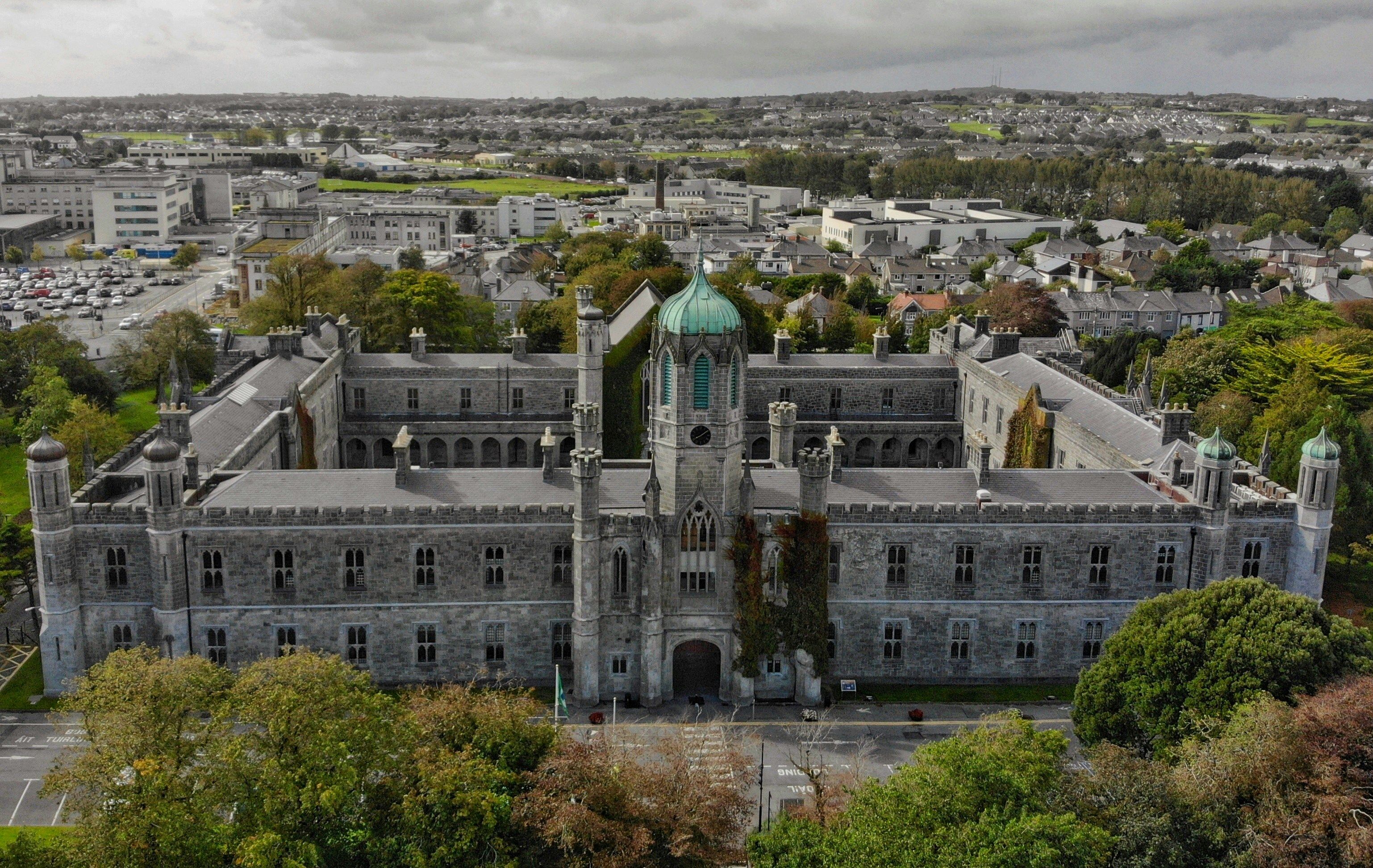
Galway city merits at least two days of your itinerary, while the wider county merits as many days as you have available. A long weekend is the practical minimum, though a week is ideal for those who want to combine the city with a proper exploration of the Wild Atlantic Way.
The three Aran Islands, known as Inis Mór (Inishmore), Inis Meáin (Inishmaan), and Inis Oírr (Inisheer), are each located at the mouth of Galway Bay, between 37km and 48km west of Galway city. All three are Irish-speaking Gaeltacht islands, where the native language is the primary one of everyday life.
Dún Aonghasa on Inis Mór is a prehistoric fort perched on the edge of a 100-metre cliff above the Atlantic, its semicircular walls open to the sea on the cliff side. The fort can be accessed by a 1km uphill walk from the visitor centre, but the views along the way make the climb all worthwhile. Bikes can be hired from several shops adjacent to the pier on Inis Mór. Ferries depart from Rossaveal all year-round, with the crossing taking approximately 40 minutes to Inis Mór.
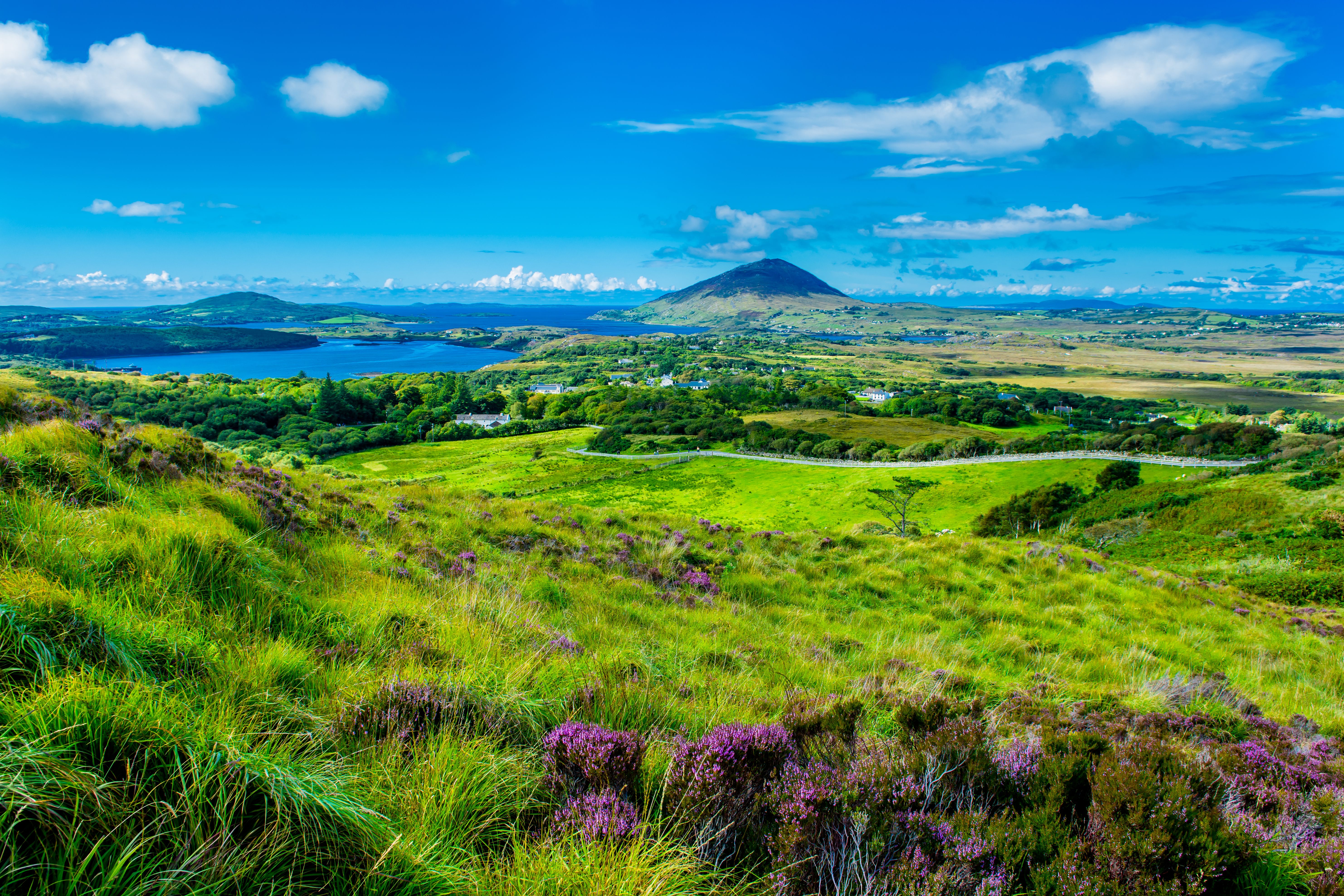
Connemara, an Irish-speaking region of County Galway, is one of Ireland’s most impressive landscapes. It features wild moorland, rugged mountains such as the Twelve Bens, quiet coastal inlets, white sandy beaches, and traditional villages. Connemara National Park near Letterfrack covers 2,957 hectares and is the best place to explore the area. Walking trails range from an easy 2-kilometre loop to the popular climb of Diamond Hill, a 3 hour round trip with panoramic views over the mountains and Atlantic coast.
For a scenic drive, the Inagh Valley route between Recess and Kylemore offers dramatic views of a glacial landscape, with Lough Inagh often reflecting the surrounding peaks on calm days.
Kylemore Abbey is one of the most photographed buildings in Ireland, and it’s easy to understand why. Located in a valley beneath Duchruach Mountain, this Victorian Gothic castle was erected between 1867 and 1871 by the Manchester businessman Mitchell Henry as a romantic gift to his wife Margaret, reflected in the still water of the lake in a setting of mountain and woodland.
The visitor experience includes the Gothic church, the Victorian walled garden and the Abbey building's public rooms. Tickets to enter cost approximately €15 for adults and €7 for children. The drive from Galway city to Kylemore through Connemara via the N59 takes approximately 1 hour and 30 minutes and is widely considered one of the most scenic drives in Ireland.
The Cliffs of Moher in County Clare, located 65km south of Galway, are the most visited natural attraction in Ireland, with more than 1.5 million visitors arriving per year to a 14km stretch of sea cliffs running along the Atlantic coast. At their highest point, they reach 214 metres, and the view south on a clear day takes in the Aran Islands in Galway Bay, the Twelve Bens of Connemara, and the mountains of Kerry.
Entry tickets for the Cliffs of Moher Visitor Centre cost approximately €8, while the cliff path is freely accessible. The best way to reach the cliffs from Galway is by boat. Several operators provide summer cruises from Galway docks and from Doolin, approaching the base of the cliffs at water level for a view that you otherwise miss from above.
The Burren, a 250 square kilometre limestone plateau in north County Clare, is one of the most unique landscapes in Ireland. It's bare grey rock supports an unusual mix of plant life, where Mediterranean and Arctic alpine species grow side by side. In late spring, the area comes alive with bright wildflowers, including gentians, orchids, and mountain avens.
One of its most famous sights is the Poulnabrone Dolmen, a prehistoric tomb dating from between 4200 and 2900 BCE. Its large capstone, balanced on two upright stones, makes it one of the most recognisable ancient monuments in Ireland. Entry to the Burren is completely free, though the Burren Visitor Centre in Kilfenora costs around €6, where you can discover more information on the region.
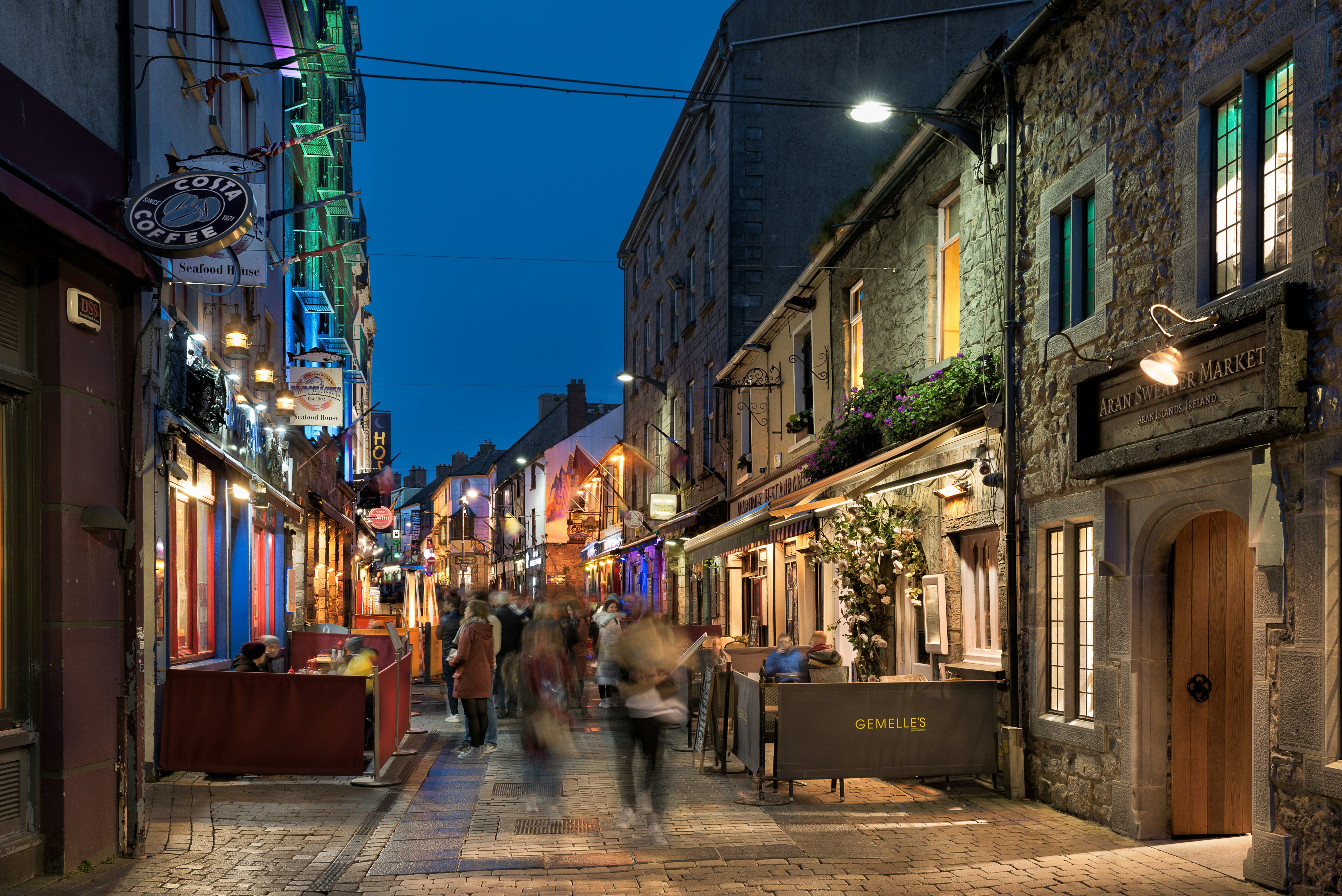
Galway's music scene is undoubtedly the best of any Irish city outside of Dublin, and the sheer number of sessions available within the city centre means that on any given night of the week, excellent live traditional music is happening within a five-minute walk of Eyre Square. The Crane Bar on Sea Road is the most celebrated traditional music pub in the city, with performances taking place every night of the week.
Tig Chóilí on Mainguard Street hosts two sessions every day. Garavan's on Shop Street is outstanding for whiskey and a consistently excellent pint. Monroe's on Dominick Street has some of the best sessions in the city in a more spacious and relaxed setting.
The Salthill Promenade, a 2km seafront walkway that runs from Galway city centre to the Blackrock diving tower, is by far the most popular outdoor experience of the city, providing excellent views of the Aran Islands on clear days. By local tradition, pedestrians kick the wall at the end of the promenade before turning back.
Kayaking on the River Corrib through the city is provided by several operators and offers a unique perspective on the city's medieval architecture. Cruises down the River Corrib depart from Woodquay between April and September, running 90-minute circuits through the city and out to Lough Corrib. For mountain walking, the Twelve Bens and the Maumturks have many routes available from short valley walks to full ridge traverses of 25km or more, all accessible within 1 hour and 30 minutes of the city by car.
Galway city is rich in history, with several historic landmarks located close to one another and easy to explore on foot.
Killary Fjord (75km north): The only fjord in Ireland is a 16km glacially carved sea inlet located between County Galway and County Mayo. Boat cruises from Leenane at the head of the fjord operate from April to October, providing spectacular views of the Mweelrea mountains above the fjord waters. The old Famine road along the southern shore is one of the most atmospheric walks in the west of Ireland, through a landscape shaped by mass emigration in the 1840s.
Clifden and the Sky Road (79km west): Clifden is the principal town of Connemara, a colourful place with an array of great restaurants, craft shops, and excellent traditional music. The Sky Road, a 16km loop starting and finishing in Clifden, climbs onto the Kingston Peninsula for some of the most dramatic Atlantic cliff and island views in Ireland.
The Burren and Cliffs of Moher (55–65km south): This day trip involves visiting both the Poulnabrone Dolmen and the wildflower limestone pavement of the Burren and an afternoon visit to the Cliffs of Moher. This circuit spans around 180km, covering two of Ireland's most remarkable natural and prehistoric landscapes in a single day. The coastal road through the Burren from Kinvara south to Doolin via Ballyvaughan and Black Head is one of the most scenic drives in the west of Ireland.
Galway is one of the best family destinations in Ireland. The ferry to the Aran Islands and a day trip to Inis Mór is a memorable full-day family adventure without needing a car. There is a range of activities to keep children entertained on the islands, including the prehistoric fort of Dún Aonghasa, the seal colony at Cill Mhuirbhigh beach, and a fish and chips lunch at a harbour café. Another great option is the Connemara National Park visitor centre at Letterfrack, which has an excellent interactive exhibition.
Kylemore Abbey's Victorian walled garden and Gothic church are suitable for children of all ages. The National Aquarium of Ireland in Salthill is a reliable rainy-day option, displaying Atlantic sea life from local Galway Bay species to deep-water sharks. The Galway Saturday Market, held in the square outside St Nicholas' Church year-round, is one of the best food and craft markets in Ireland and a free morning for all ages.
Galway is an easy city to enjoy on a budget, with many of its top attractions costing absolutely nothing. You can visit the Galway City Museum, the Spanish Arch, admire the exterior of Lynch’s Castle, and explore the Hall of the Red Earl without paying anything. St Nicholas’ Collegiate Church is also open to visitors, though a small donation is appreciated. A walk along the Salthill Promenade offers beautiful views over Galway Bay at no cost, and the Saturday Market outside St Nicholas’ is free to browse.
Beyond the city, Connemara National Park and the Poulnabrone Dolmen in the Burren are both free to visit, making day trips very affordable. Back in the city centre, you can enjoy some of Ireland’s best street performers along Shop Street and Quay Street throughout the year. For food and drink, a pint of Guinness in a pub slightly away from the busiest parts of Quay Street typically costs between €5.50 and €6.50. If you are travelling from Dublin, booking a Citylink coach in advance can bring fares down to as little as €10 one way.
Brigit’s Garden in Rosscahill, located around 20 kilometres east of Galway, is one of the most beautiful gardens in the west of Ireland. Set across 11 acres of woodland and meadow, it features four themed gardens inspired by the Celtic seasons, along with a reconstructed Bronze Age ring fort.
Off the coast of northern Connemara, Inishbofin Island is situated 11 kilometres from Cleggan and can be reached by ferry in approximately 45 minutes. This tranquil, car-free island is known for its white sandy beaches, an ancient Iron Age fort, and a remarkable traditional music scene.
For a scenic drive, the Roundstone Bog Road runs south from Recess to the fishing village of Roundstone. This route passes through vast stretches of blanket bog, with lakes, turf cuttings, and uninterrupted views of the Twelve Bens, creating a remote and atmospheric landscape. If you decide to stop in Roundstone village, Malachy Kearns’s workshop offers a rare chance to see traditional Irish bodhrán drums being made by hand. Visitors are welcome to watch the process and learn about this unique craft.
Galway's food scene has developed into one of the most exciting in Ireland, anchored by the exceptional quality of its local seafood. The defining Galway food experience is the native Galway oyster, farmed in the cold waters of Galway Bay and served at the city's oyster bars, the Saturday Market, and at the Galway International Oyster Festival that takes place every September. They are typically eaten raw with a squeeze of lemon and a glass of Guinness and are widely considered among the finest oysters in the world.
Galway has two restaurants that have been awarded Michelin stars: Aniar on Dominick Street and Loam, both of which specialise in locally-sourced ingredients. There is also a wider community of excellent independent restaurants in the Latin Quarter. McDonagh's on Quay Street, opened in 1902, is the city's most venerable fish and chip restaurant and serves what many consider to be the best traditional fish and chips in Galway.
Galway has a whole range of accommodation, with the most desirable options located around the Latin Quarter and on the Salthill seafront. By staying in the city centre, you are within easy walking distance of trad music and restaurants, while also getting the full Galway experience without any need for transport within the city.
The Galway city hotel market ranges from the five-star G Hotel and Spa through the centrally located four-star hotels on Eyre Square and the docks to a wide range of independent guesthouses in the residential streets off the main thoroughfares. The Salthill seafront, 3km west, provides a quieter and slightly more affordable alternative base with direct promenade access.
You can book accommodation in Galway via our accommodation page or directly with properties for the best rates.
Galway is best suited for an Irish road trip. You can use the city as a base from which to explore Connemara, the Aran Islands, the Cliffs of Moher, and the Burren. Rather than hiring a rental car when you arrive, bring your car on the ferry crossing. The Holyhead to Dublin ferry, followed by the M6 west, is the fastest approach.
Alternatively, the Fishguard to Rosslare ferry or Pembroke to Rosslare ferry, followed by the drive north through Waterford and Limerick, suits those wanting to take in the south of Ireland on the way.
Duration: 2–3 days
Arrive in Galway by taking the ferry from Holyhead to Dublin and driving west for 2 hours on the M6. Check in and visit the Latin Quarter, exploring Shop Street, Quay Street, the Spanish Arch, and the Long Walk. Visit the Saturday Market if arriving on a Saturday morning. In the evening, have dinner in the Latin Quarter and enjoy a trad session at Tigh Neáchtain or the Crane Bar. Stay overnight in the city centre.
Take the Aran Islands ferry from Rossaveal. Hire a bike at the pier and cycle to Dún Aonghasa. Have lunch at a Kilronan café. Return to Galway by late afternoon. In the evening, walk the Salthill Promenade and kick the wall. Have dinner at McDonagh's on Quay Street or one of the Dominick Street restaurants. Stay overnight in the city centre.
Drive west into Connemara on the N59 via Oughterard, the Inagh Valley detour between the Maumturks and the Twelve Bens, and arrive at Kylemore Abbey for the Victorian walled garden and Gothic church. Return via Clifden and the Sky Road for the Atlantic clifftop views. Return to Galway city or drive east to Dublin for the Dublin to Holyhead ferry.
Why we love it: The Holyhead to Dublin ferry — with multiple daily sailings and crossing times from 2 hours 15 minutes — puts you in Galway city for an afternoon arrival, and the compact Latin Quarter delivers everything that makes Galway's reputation within the first evening's walk. The Aran Islands day trip is the single most rewarding excursion available from any city in Ireland.
Duration: 7 days
Arrive via the Fishguard to Rosslare ferry or the Pembroke to Rosslare ferry. Drive north-west for 3 hours via Waterford and Limerick to Galway. Spend the evening in the Latin Quarter. Stay overnight in Galway.
Spend the day in Galway city, exploring Spanish Arch, Galway City Museum, Lynch's Castle, St Nicholas' Church, and Saturday Market if Saturday. Afternoon: Salthill Promenade walk. Evening: trad session at the Crane Bar. Stay overnight in Galway.
Visit the Aran Islands by taking the ferry from Rossaveal to Inis Mór. Once you arrive in Dún Aonghasa, do a bike circuit of the island and have lunch in Kilronan. Return late afternoon. Stay overnight in Galway.
Drive into Connemara — Inagh Valley, Kylemore Abbey, lunch in Clifden, Sky Road clifftop loop. Return via the coast road through Roundstone. Overnight in Clifden or back in Galway.
Drive south to the Cliffs of Moher via the Black Head coastal road. Visit the Cliffs of Moher in the afternoon. Stay overnight near Doolin or Lahinch in County Clare.
Drive north back to Galway via Kinvara and the Burren coastal road. Spend the afternoon in the city, exploring the Latin Quarter and enjoy a final trad session. Spend overnight in Galway.
Drive east for 2 hours to Dublin on the M6 for the Dublin to Holyhead ferry, or south to Rosslare Europort for the Rosslare to Fishguard ferry or Rosslare to Pembroke ferry.
Why we love it: This weeklong itinerary uses the ferry, either via Dublin or Rosslare, to place Galway at the heart of a journey along the Wild Atlantic Way. From this base, you can explore the Aran Islands, Connemara, the Twelve Bens, Kylemore Abbey, the Cliffs of Moher, and the Burren in one logical route without backtracking.
It offers one of the best driving and sightseeing experiences accessible from Ireland’s ferry ports and stands out as one of the most memorable travel itineraries in the British Isles.
There is no direct ferry from the UK to Galway, but the city is easily reached by combining a ferry crossing with a straightforward drive. The Holyhead to Dublin ferry, operated by Irish Ferries and Stena Line, sails up to ten times per day with a crossing time of 2 hours and 15 minutes, followed by a 2-hour drive west on the M6.
The Fishguard to Rosslare ferry and the Rosslare ferry are each followed by an approximately 3-hour drive north-west. The overnight ferry from Liverpool to Dublin, operated by P&O Ferries, takes approximately 8 hours and is a convenient option for visitors travelling from northern England.
Bringing your car is highly recommended for getting the most out of Galway and County Galway. Although the city itself is walkable, attractions like Connemara National Park, Kylemore Abbey, the Sky Road, the Cliffs of Moher and the Burren are all best explored by car. Bringing your vehicle on the Holyhead to Dublin ferry or the Fishguard to Rosslare ferry is the most practical solution for a holiday to Galway.
Here are some of our favourite tips and tricks that will be useful to know on your holiday to Galway.
More routes than anyone else.

Compare fares, times & routes in one place.
Change plans easily with flexi tickets.

Book e-tickets & manage trips in-app.
Live ship tracking & real-time updates.

Top-rated customer support when you need it.