Travel checklist: Packing for the ferry
Ferry travel tips
Ferry travel tips


Travelling by ferry is more than just getting from A to B — it’s all part of the experience. With beautiful views and time to relax, your holiday begins the moment you step on board. As the ship sails across the water, there’s a real sense of anticipation and adventure. To help your crossing go as smoothly as possible, it’s worth planning a few things in advance.
In this article, you’ll find useful tips for your ferry journey, including what to look out for, what to pack, and inspiration for your next holiday.
You can use our price finder to compare prices, routes and operators, and book your ferry journey in just a few steps. You will then find all the important information in your booking confirmation. Check-in times and procedures vary depending on the ferry company and route. However, we recommend arriving at the departure port as early as possible – especially during the high season, when it can get busy.
Depending on the duration of the journey, you may need to decide whether to book a seat or a cabin. On longer or overnight crossings, a cabin is significantly more comfortable, but it is also more expensive than a seat. For shorter journeys, however, a seat will suffice, or you might even be happy to spend your time in the public areas.
Please also note that many ferry companies offer accessible and/or pet-friendly cabins and lounges. Depending on how you are travelling and what your requirements are, these can make your journey much easier.
Don’t forget to have all your important documents to hand:
Top tip: Save important documents offline on your smartphone and/or print them out.
If you are bringing your car, motorbike or campervan with you, there are a few additional things to bear in mind.
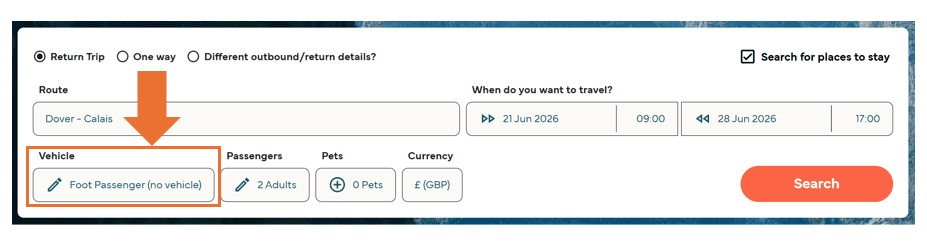
During the booking process, select your vehicle type using the ‘Vehicle’ button, provide details of the make and model, and, if applicable, specify the dimensions of the vehicle or any attachments (roof box, trailer, etc.). This is important so that you can be allocated the correct space on board.
Make sure you also check which vehicle documents you need to take with you on your journey. These may include your driving licence and vehicle registration documents, and your insurance cover. Remember that some insurance policies do not automatically apply in all countries.
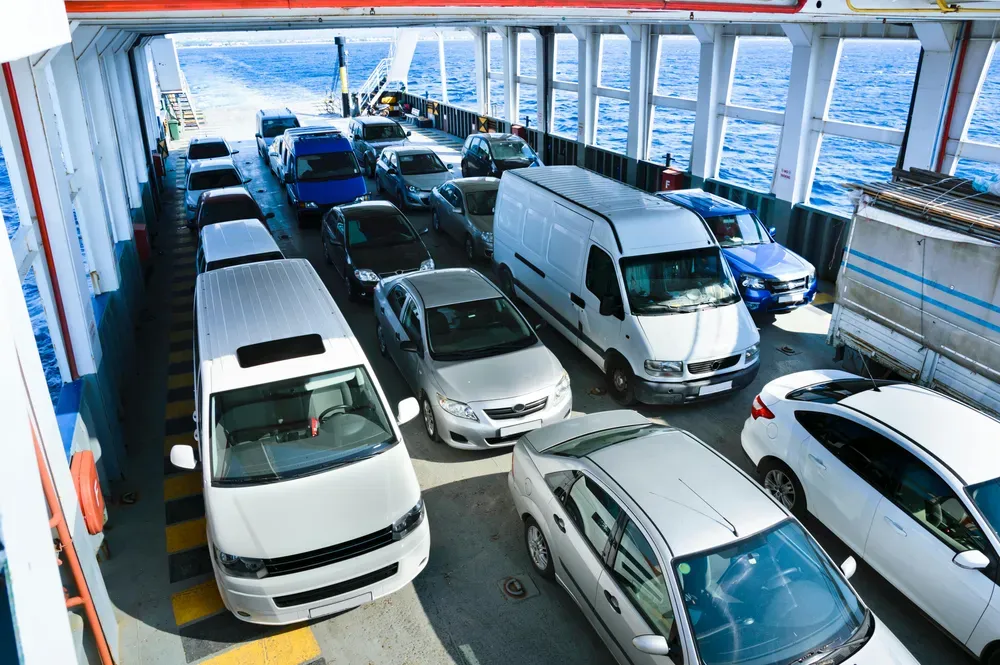
Always follow the staff’s instructions when boarding. Once on board, apply the handbrake and make sure your vehicle is secure. Before leaving the car deck, double-check that you’ve taken everything you’ll need during the crossing with you.
Related articles:
Europe holidays with a motorhome
European road trip
Driving to France from the UK
You can take your four-legged friend with you on many ferries – after all, they’re part of the family. What the journey entails depends entirely on the ferry company and the route.
Depending on the ferry operator, journey time, type of trip and the size/type of animal, your pet may travel:
Some ferries have outdoor areas where you can take your dog for a walk. Your packing list for your pet will depend on the ferry’s location and facilities, as well as the company’s guidelines, e.g. blankets, toys, food/water, waste bags, lead, muzzle, etc.
For travel within the EU, your pet must, as a minimum:
Regulations may vary depending on your destination. Please check the exact regulations before you travel.
Related articles:
Ferry travel with pets
Travelling with pets in summer
On longer journeys, you’ll probably have more luggage with you. If you’re travelling by car, you can leave your suitcases in your vehicle. Please note, however, that for safety reasons you won’t have access to the vehicle deck whilst the ship is underway.
As a foot passenger, you can usually store your luggage in a luggage hold, but you’ll likely only be able to access it once you arrive at your destination port.
Therefore, we'd recommend packing a small piece of hand luggage to take with you on board. This should contain the most important items, e.g.:
Top tip: Download films, TV series or music in advance. The internet connection on ferries can be patchy when out at sea.
The facilities vary depending on the ferry company, the ship and the route. From snack bars to restaurants, entertainment for all ages, souvenir and duty-free shops, and even wellness areas, the range of facilities on offer can vary considerably. We recommend that you check the facilities on your ferry before you travel.
Related articles:
Ferry travel: what to do on board
Fancy a trip to France? There is so much choice when it comes to ferries from England to France, so you can choose the crossing that suits you best. Dover to Calais is the quickest route, taking just 1 hour 30 minutes - ideal if you’re short on time or want the fastest way into France. Heading to Normandy? Caen and Dieppe are popular gateways, offering easy access to the region’s historic towns and coastline. Meanwhile, if you’re travelling to Brittany, crossings to St Malo and Roscoff are great options.
Popular UK to France ferry routes include:
| Route | Operators | Duration | Sailings |
| Dover to Calais | Irish Ferries, P&O Ferries & DFDS Seaways | 1 Hours 40 Minutes | 25 sailings per week |
| Dover to Dunkirk | DFDS Seaways | 2 Hours | 9 sailings per week |
| Portsmouth to Caen | Brittany Ferries | 6 Hours | 3 sailings per week |
| Newhaven to Dieppe | DFDS Seaways | 4 Hours | 2 sailings per week |
| Poole to Cherbourg | Brittany Ferries | 4 Hours 45 Minutes | 1 sailing per week |
| Plymouth to Roscoff | Brittany Ferries | 9 Hours | 1 sailing per week |
| Portsmouth to St Malo | Brittany Ferries | 11 Hours | 1 sailing per week |
Related articles:
The most beautiful medieval towns in France
The must-see tourist sites in France
Dover to Calais: Complete ferry and travel guide
Your Channel ferry guide
You can also get direct ferries from the UK to the Netherlands, with regular routes from Harwich, Hull and Newcastle, all offering easy access to Amsterdam and the rest of the country. Thanks to the country's great road and rail links, ferries to the Netherlands are also a great option if you’re continuing your journey on to Belgium or Germany.
Popular UK to Netherlands ferry routes include:
| Route | Operators | Duration | Sailings |
| Harwich to Hook of Holland | Stena Line | 7 Hours 15 Minutes | 2 sailings per week |
| Hull to Rotterdam | P&O Ferries | 11 Hours 45 Minutes | 1 sailings per week |
| Newcastle to Amsterdam | DFDS Seaways | 15 Hours 45 Minutes | 2 sailings per week |
Do the sunny shores of Spain take your fancy? You can get ferries from the south coast of England to both Santander and Bilbao in northern Spain. These overnight crossings are great if you don't fancy losing valuable daytime hours. Once you've reached the north coast of Spain, you can easily go on to explore major cities like Madrid and Barcelona.
Popular UK to Spain ferry routes include:
| Route | Operators | Duration | Sailings |
| Plymouth to Santander | Brittany Ferries | 21 Hours 45 Minutes | 1 sailing per week |
| Portsmouth to Santander | Brittany Ferries | 9 Hours | 1 sailing per week |
| Portsmouth to Bilbao | Brittany Ferries | 9 Hours | 1 sailing per week |
Related articles:
Your guide to taking the ferry from the UK to Spain
The Channel Islands are also easy to reach from the UK, with regular crossings to Jersey and Guernsey. They’re a popular choice for weekend getaways, especially the shorter crossings from Poole. Once you’ve explored the islands, you can even continue your journey to France by ferry.
Popular UK to Channel Islands ferry routes include:
| Route | Operators | Duration | Sailings |
| Poole to Jersey | DFDS Seaways | 4 Hours 30 Minutes | 1 sailing per week |
| Poole to Guernsey | 3 Hours | 1 sailing per week | |
| Portsmouth to Guernsey | 10 Hours 15 Minutes | 1 sailing per week | |
| Portsmouth to Jersey | DFDS Seaways | 9 Hours 15 Minutes | 1 sailing per week |
Related articles:
This is your sign to visit Guernsey
If you are travelling with a vehicle, you can leave most of your luggage in your vehicle. As you will probably not have access to the vehicle deck during the crossing, it is worth packing a small piece of hand luggage for your time on board.
As a foot passenger, you take all your luggage on board with you. Regulations vary depending on the ship, ferry company and route:
This varies depending on the ship, the ferry company and the route. Some ferries have no luggage restrictions, and even on routes with luggage regulations, the limits are usually very generous (often up to 50 kg). As a general rule, foot passengers must be able to carry their own luggage. Please check with the relevant ferry company before you travel.
Special regulations often apply to surfboards, sports equipment, large musical instruments and similar items. Here too, the regulations vary depending on the shipping company, but in most cases you must declare bulky luggage in advance and check it in separately. If you are unsure whether one of your items of luggage is classified as bulky luggage, please contact the ferry company in advance to avoid disappointment when boarding.
If you’re flying to your destination first and then exploring the area by ferry, you should follow the airline’s regulations. These are stricter than on ferries, so you probably won’t be able to make full use of the generous luggage allowances on board. So when shopping for souvenirs, always remember that you still have to fly home!
That depends on the regulations of the car hire company and the ferry operator. Depending on how far you intend to take the hire car (e.g. within a country or across borders), the regulations may differ. This is primarily for insurance reasons.
A ferry journey is a wonderful way to travel at a more leisurely pace and take the time to unwind before you reach your destination. With the right preparation, a well-thought-out packing list and a bit of planning, you’ll set yourself up for a relaxed crossing.
Find your ferry now and make the journey part of your holiday. You can also find inspiration on our blog and our Instagram account.